Integrated Enterprise for Design, Customization and Production of Acrylic Display Products
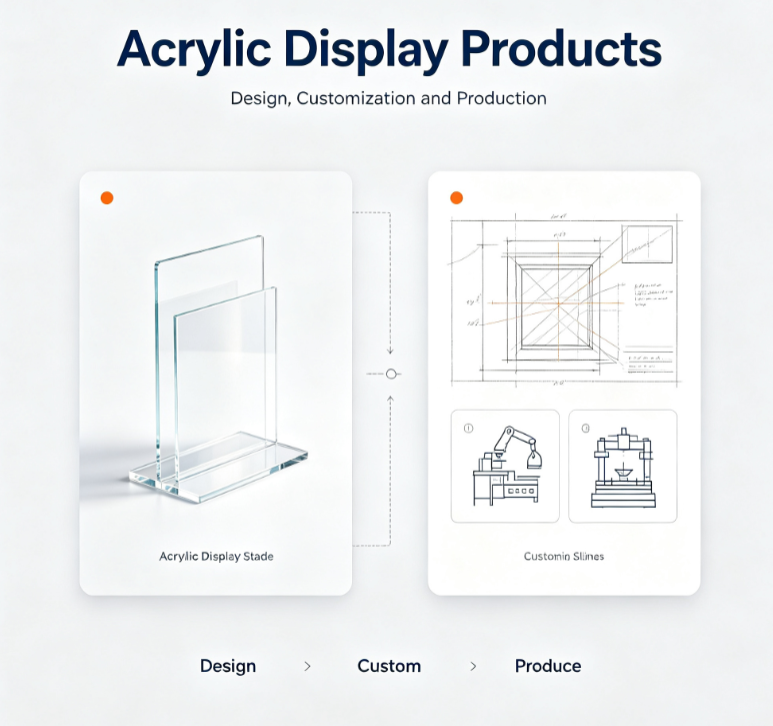
Table of Contents
Acrylic Material: Why It Dominates the Premium Display Industry
Design: From Concept to Manufacturable Solutions
Customization Capabilities: Meeting Diverse Business Needs
Production Processes: From Sheet to Finished Product
Quality and Quality Control Systems
FAQ
1. Acrylic Material: Why It Dominates the Premium Display Industry
Acrylic has become the material of choice for retail displays, brand events, and corporate image presentations for good reason. Its optical clarity approaches that of glass—transparent sheets achieve light transmittance of up to 93%—yet it weighs only half as much as glass of the same thickness and offers significantly higher impact resistance.
More importantly, acrylic does not yellow or become brittle due to UV exposure, maintaining long-term stability in both indoor and outdoor environments. For retail brands displaying high-value merchandise, material durability and visual quality directly affect brand perception.
Acrylic's workability is another critical advantage. It can be shaped through cutting, drilling, milling, laser cutting, heat bending, and thermoforming into virtually any form. This processing flexibility, combined with available surface finishes—high-gloss, matte, anti-glare, scratch-resistant coatings, and more—makes acrylic an ideal platform for display product design.
Industry data: China is the primary global production hub for acrylic display products, with Zhejiang and Guangdong provinces forming highly concentrated industrial clusters. Wenzhou-based manufacturers excel in precision cutting and custom exhibition-grade displays, while Shenzhen suppliers leverage their proximity to the electronics and digital printing industries to integrate smart design features into their products. This industrial agglomeration enables manufacturers to achieve end-to-end control—from raw material procurement to finished product packaging—significantly shortening lead times.
2. Design: From Concept to Manufacturable Solutions
Design is the starting point of the acrylic display product value chain. An integrated enterprise's design capabilities encompass not only aesthetic creativity but also engineering feasibility—a beautifully designed display stand is ultimately a failed design if it cannot be efficiently produced through available processes or lacks structural stability in use.
A professional design process typically includes:
Requirement analysis and concept generation: Understanding the display environment, target audience, and brand identity.
CAD modeling and 3D rendering: Using CAD software and 3D modeling techniques to create accurate visualizations, allowing clients to preview the final result before physical production.
Structural analysis and manufacturability assessment: Evaluating wall thickness, support structures, connection methods, and more to ensure the design is producible and structurally sound.
Prototyping and testing: Integrated enterprises typically possess rapid prototyping capabilities, enabling physical validation within days to identify design flaws before mass production.
Material selection considerations in design: Based on specific application requirements, choices can be made between cast and extruded acrylic—cast grade offers superior optical clarity—while specialized sheets such as UV-resistant, anti-static, scratch-resistant coated, and impact-modified grades are available for specific applications.
3. Customization Capabilities: Meeting Diverse Business Needs
"Customization" is the core value of the acrylic display product market. Retail brands need display stands that precisely match their brand identity, product characteristics, and spatial layout—standard off-the-shelf products often cannot meet these requirements.
An integrated enterprise's customization capabilities typically cover the following dimensions:
Customization Dimension | Range of Options |
Material Thickness | 2mm to 20mm (cast grade up to 100mm) |
Color and Transparency | Transparent, translucent, opaque, colored, frosted, mirrored |
Surface Finishes | High-gloss, matte, anti-glare, scratch-resistant, UV-filtering coatings |
Shape and Structure | Laser/CNC cut, heat-bent, thermoformed, multi-layer laminations |
Mounting Methods | Wall-mounted, tabletop standing, magnetic, modular combinations |
Surface Decoration | UV printing, screen printing, laser engraving, hot stamping, labeling |
Industry practice: For example, Wenzhou Lianming Acrylic Products accepts MOQs as low as 10 pieces with rapid turnaround, making them ideal for testing new designs or limited-edition display projects. This flexibility is particularly important for brands implementing seasonal display updates.
4. Production Processes: From Sheet to Finished Product
Integrated enterprises consolidate multiple processing capabilities within a single production system, ensuring end-to-end control from raw material to finished product. Key processes include:
Cutting and Forming
Laser cutting: High precision for fine contours and complex patterns
CNC milling: Suitable for thick sheets and three-dimensional shapes
Waterjet cutting: Suitable for large-format sheets with no heat-affected zone
Heat bending and thermoforming: Heating sheets then bending or pressing into three-dimensional shapes
Joining and Finishing
Bonding: Seamless connections using acrylic-specific adhesives
Polishing: Flame polishing or mechanical polishing to restore edge transparency
Printing and engraving: UV flatbed printing, screen printing, laser engraving for branding and decorative patterns
Vertical integration advantage: Integrated manufacturers with complete production equipment and in-house engineering teams can iterate rapidly with clients during product development, shortening feedback cycles between design changes, material adjustments, and sample modifications.
Case example: Harrison Products Ltd, as a retail display solution partner to multiple global brands, maintains in-house acrylic manufacturing facilities and a product design team, providing end-to-end service from concept design to final delivery. In the Dobbies flagship store project, their design team worked closely with the client through prototyping and sample validation for multiple custom display solutions, ultimately delivering approximately 200 pallets of custom display equipment.
5. Quality and Quality Control Systems
The quality of acrylic display products directly affects end-user brand perception. An integrated enterprise's quality control covers the entire process from raw materials to finished products:
Incoming material inspection: Optical performance, thickness tolerance, and surface quality verification of PMMA sheets.
In-process inspection: Key control points including cutting precision, heat-bending angle consistency, and bubble-free bonding.
Final inspection: Dimensional accuracy, visual defects, assembly completeness, and functional testing.
Environmental compliance: REACH compliance, free from harmful substances, fully recyclable through pyrolysis processes.
Supplier evaluation metrics: According to B2B procurement data, when evaluating acrylic display product suppliers, consider operational metrics such as on-time delivery rate above 95%, response time under 3 hours, and reorder rates as indicators of customer satisfaction and product consistency.
6. FAQ
Q: What is the difference between cast acrylic and extruded acrylic?
Cast acrylic offers superior optical clarity, a wider thickness range, and better machining properties, making it suitable for premium displays and high-precision applications. Extruded acrylic has more uniform thickness and lower cost, making it suitable for high-volume standard products. Cast acrylic is available in thicknesses from 2mm to 100mm.
Q: How can acrylic display products be protected from scratches?
Scratch-resistant coated acrylic is available for added protection, particularly suitable for high-traffic retail environments or applications requiring frequent cleaning. For daily cleaning, use a soft cloth and mild cleaning agents, avoiding abrasive cleaning products.
Q: Are acrylic display products suitable for outdoor use?
Yes. Acrylic has excellent UV resistance and does not yellow or degrade from sunlight exposure. For applications requiring higher UV protection, UVF-grade or PFG UVF-grade sheets are available, filtering up to 98% of harmful UV radiation.
Q: What is the minimum order quantity for custom acrylic display stands?
MOQs vary by supplier. Professional acrylic processing suppliers typically offer MOQs as low as 10-50 pieces, suitable for prototyping and small-batch projects. High-volume production significantly reduces per-unit costs, with some suppliers achieving unit prices as low as $0.40 for orders above 100 pieces.
Q: Can acrylic display stands be fully recycled?
Yes. PMMA acrylic material can be fully recycled through pyrolysis processes, with recovered raw materials reused in the production cycle to manufacture new sheets.
Q: How can I ensure my acrylic display product design meets production requirements?
Choosing an integrated supplier with manufacturability assessment capabilities is crucial. Professional suppliers participate in design reviews early in product development, providing engineering recommendations on wall thickness, structural supports, connection methods, and material selection, identifying potential issues before physical production.